


Tea and Infamy visits Savannah - Day One
Updated: Jan 27
By Elizabeth Kerri Mahon
Happy January and welcome new followers! I apologize for my tardiness in posting this month. The past few weeks have been a bit of a nightmare in the US. There have been some bright spots (Figure Skating, the upcoming fourth season of Bridgerton, movies, spending time with friends), but for the most part, every day, I wake up with a sense of dread. I don’t want to be Debbie Downer, so I’m going to share some of the highlights of my trip to Savannah, GA.
The impetus for this trip was an email from JetBlue informing me that I had 2 weeks to book a trip with the funds in my JetBlue account, or I would lose them. Yikes! I debated booking a trip to either Chicago (too cold) or New Orleans (currently planned for February). Instead, I decided to book a trip to a city that I’d never been to before but was on my bucket list. Savannah. Like pretty much everyone in the 90s, I read John Berendt’s non-fiction book MIDNIGHT IN THE GARDEN OF GOOD AND EVIL. Savannah is also the birthplace of Juliette Gordon Low, who founded the Girl Scouts of America in 1912.
My hotel was the Hilton Garden Inn Historic District, located at the end of East Bay Street. A friend stayed there back in May and highly recommended it. My room wasn’t ready when I arrived, so I moseyed on over to the Olde Pink House for lunch. I’m not going to lie, I got lost on my way to the restaurant. It took me a while to get oriented, but after a few wrong turns, I finally made it to the restaurant. Now, usually, it’s hard to get a reservation at the restaurant, and I absolutely didn’t book ahead. I assumed, rightly, that since it was almost 2 pm, I wouldn’t have a problem sitting at the bar for lunch.

Located in the heart of Savannah’s National Historic Landmark District, The Olde Pink House is in Savannah’s only 18th-century mansion. Initially built in 1771 as the home of James Habersham, Jr., this National Landmark overlooking Reynolds Square has earned numerous culinary awards. Lunch at the Olde Pink House is less expensive than dinner, which is another plus. I ordered the crab cake with fried green tomatoes and a Pink Lady cocktail. It was a delicious way to start my trip in Savannah. I got lucky, but I would suggest that if you want lunch or dinner at the Olde Pink House, you make reservations in advance.
I learned two things about Savannah on my first day: no one is in the square where they should be, and there are more monuments to the American Revolution than to the Civil War. What do I mean by no one is in the square where they should be? Well, the statue of James Oglethorpe is in Chippewa Square, not Oglethorpe Square; the statue of Casimir Pulaski, a Polish nobleman who was fatally wounded after the siege of Savannah, is located in Monterey Square, not Pulaski Square, and the statue of Nathaniel Greene is in Johnson Square instead of Greene Square. It’s weird. The squares are lovely and a great place to sit when your feet get tired. There’s even a square named after the Marquis de Lafayette, who visited Savannah during his tour of the United States in 1824-25.

My room was ready by 3 pm, so I dropped off my bag and then headed over to the Juliette Gordon Low Birthplace Museum. I was a Girl Scout for five years, so I had to make a pilgrimage to the founder’s birthplace. I wish that I’d had enough time to see the Andrew Low House, where Juliette lived when she married William Low, or the first headquarters of the Girl Scouts, but I was only in Savannah for four days, and two of them were traveling days.
Juliette Magill Kinzie Gordon (1860-1927) was born on Halloween, a few months before the Civil War was declared. Her parents were a mixed marriage; her father, William, was a native Georgian, and her mother, Eleanor, was from Chicago. From childhood, Juliette was nicknamed Daisy. My favorite story about her parents is that when William was showing Eleanor around the library at Yale University, she slid down the banister! Can you imagine what that must have been like while wearing a crinoline? Daisy was raised in a prominent Savannah family that believed in community service, education, and being good neighbors, but they also enslaved people to work in their household and businesses.

Juliette Magill Kinzie Gordon (1860-1927) was born on Halloween, a few months before the Civil War was declared. Her parents were a mixed marriage; her father, William, was a native Georgian, and her mother, Eleanor, was from Chicago. From childhood, Juliette was nicknamed Daisy. My favorite story about her parents is that when William was showing Eleanor around the library at Yale University, she slid down the banister! Can you imagine what that must have been like while wearing a crinoline? Daisy was raised in a prominent Savannah family that believed in community service, education, and being good neighbors, but they also enslaved people to work in their household and businesses.
Juliette fell in love with William Low, the son of wealthy British businessman Andrew Low, who owned a house in Savannah. Juliette’s parents worried that her betrothed was nothing but a dilettante, but she was determined to marry him. They were married at the family home in 1886 and moved to England, but the marriage proved to be unhappy.
Juliette was unable to have children, and her husband was more concerned with hunting, fishing, and shagging other men’s wives. Juliette had lost most of her hearing due to illness, and at her wedding, guests threw rice at the newlyweds, a good-luck tradition at the time. Unfortunately, a grain of rice went into her ear. When the doctor tried to remove the piece of rice, he punctured her eardrum.
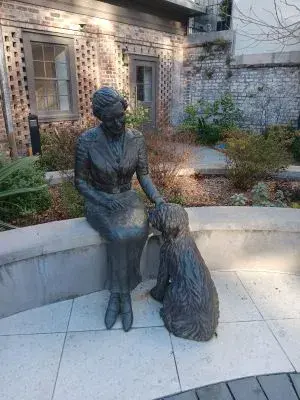
William thought it was funny to either mumble or talk really low so that Juliette couldn’t understand what he was saying. What a guy! When he died in 1905, he left most of his estate to his mistress. Juliette and his sisters sued his estate and won. She spent several years traveling around the globe, but felt restless and at loose ends. If she wasn’t a wife or a mother, what was her purpose in life?
It was a chance encounter with Robert Baden-Powell, the founder of the Boy Scouts, in 1911 that turned Juliette’s life around. He suggested that she work with the Girl Guides, the sister group to the Boy Scouts. Juliette was so enthusiastic about her work with the Girl Guides that she decided to bring the concept to her home country. The first official meeting of what eventually became the Girl Scouts of America was held in 1912. And the rest is history!
Juliette worked tirelessly to grow the new organization. For years, she used her own money to pay expenses, even selling a valuable pearl necklace when the organization was short of funds. Using her innate talent for fundraising and public relations, combined with her vast network of friends and supporters, Juliette led Girl Scouts with passion and determination.

When she passed away after a long struggle with breast cancer in 1927, she asked to be buried in her Girl Scout uniform. In 2012, 100 years after she founded the organization, President Obama awarded Juliette the Presidential Medal of Freedom. Walking around the birthplace, which looks like she just stepped out for a bit, you get a real sense of what life was like for a wealthy family in Savannah after the Civil War.
My only quibble is that I wish there were a guidebook to the birthplace. There were tons of Girl Scout Memorabilia and biographies of Gordon Low in the gift shop, but a guide to the house would have made a great souvenir. No Girl Scout cookies, though! When I worked for the national office in New York, there were Girl Scout cookies everywhere! I miss that.
I highly recommend visiting the Juliette Gordon Low Birthplace museum, even if you weren’t a Girl Scout.
Elizabeth Kerri Mahon is a native New Yorker, actress, and history geek. Pretty Evil New York: True Stories of Mobster Molls, Violent Vixens, and Murderous Matriarchs (Globe Pequot Press), her first foray into historical true crime came out in October 2021.
You can find her and more of her writing on substack at the link provided: Elizabeth Kerri Mahon | Substack
Comments